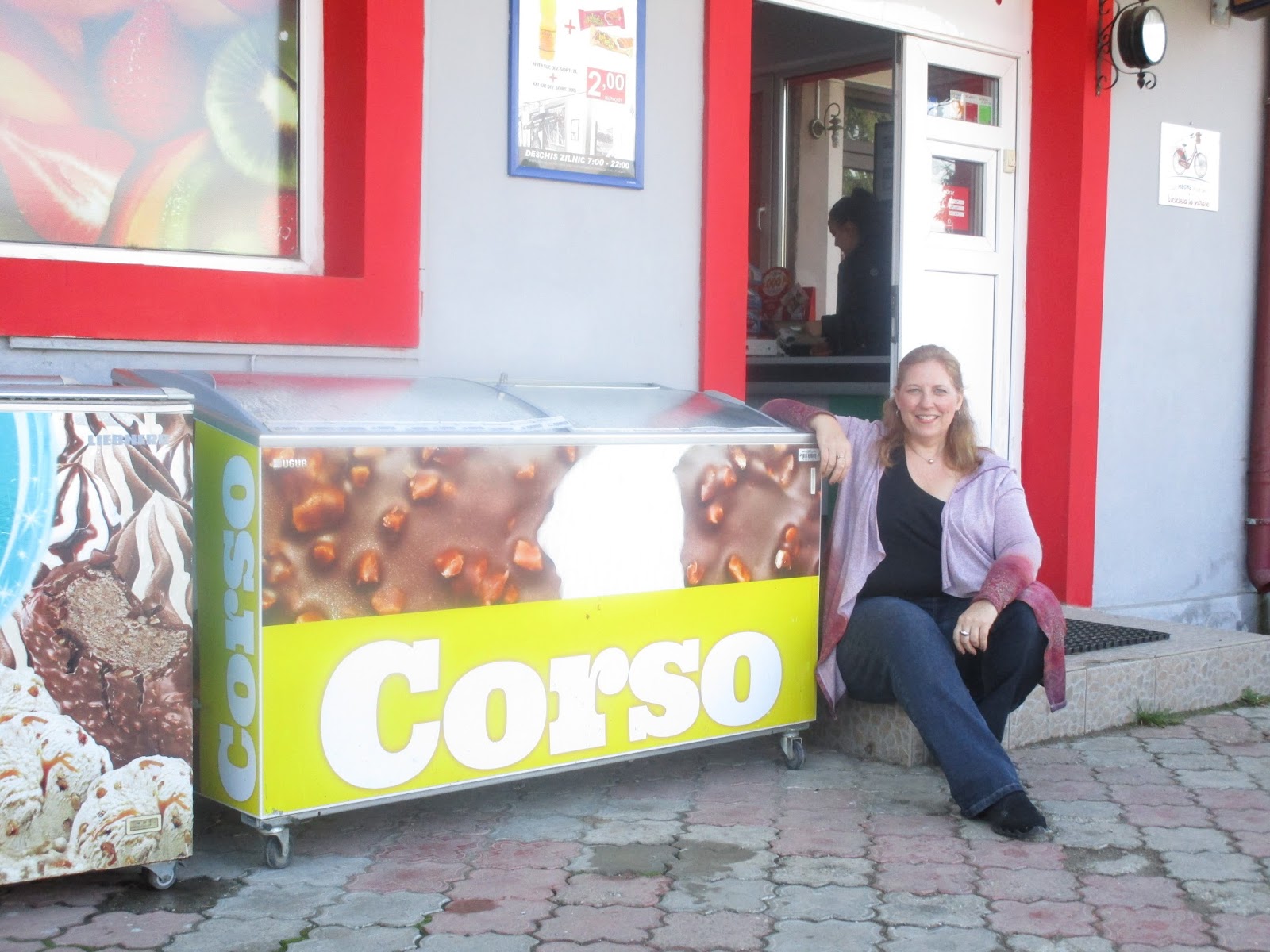
Thursday, October 29, 2015

It’s Bucharest! (Not Budapest.)


Laura and I really had only a day and a half in Bucharest, our final destination on this trip. We started out with lunch at Caru’ cu Bere – the Beer Wagon restaurant. This is a gorgeous place with a huge outdoor patio. A “student’s lunch”, consisting of 4 courses (soup, salad, main and dessert), is served daily for about $6. This was a very good start to a short time in Bucharest.

We left lunch to join an afternoon walking tour. In just a few hours we covered a lot of ground, and heard a lot about the communist regime under Ceausescu from the 60’s through the 80’s, and how Romania has been transitioning into democracy since then. At one point, our tour guide noted how many celebrities, including Michael Jackson, Lenny Kravitz, and Ozzy Osbourne, have come to Bucharest and thanked the lovely people of Budapest for having them there. It’s become so much of a joke that they’ve even created a website devoted to it. Of course, once this was said it was in my brain, and for the next day and a half I was constantly making the mistake of saying Budapest! Very embarrassing.

Due to massive reconstruction during Ceausescu rule, Bucharest architecture is an odd mix. Vast amounts of historical buildings were demolished and replaced with communist style apartment buildings. Luckily, a good portion of the “old town” remained preserved, which features a lot of French-inspired architecture. Most of the grand old mansions and palaces that remain have been converted to museums, banks or high end hotels. Local architects developed a system to move entire churches and other historical buildings to save them from demolition, and they were randomly placed wherever there was room. The end result is a rather schizophrenic looking city combining old and new, beautiful, ugly and just plain weird.

Our last day started with renting bikes and taking a long (2+ hours) ride through Herastrau Park and around Lake Herastrau. Being off season, rental paddle boats and tour boats were docked, rose gardens had already been clipped down, and most of the lakeside restaurants were closed for the season. But the trade-off is that we had the entire park mostly to ourselves.

After our ride, killer fatigue started to set in, and we just couldn’t decide what to see or do next. It also started raining, ending our streak of nice fall weather. So we had lunch and made appointments for a little pampering – it was massage time. The massages were great, but the rest of the day just didn’t fall into place. Luckily, we were able to salvage the day with a late night bite at a cute restaurant in Old Town, then returned to the hostel to pack up, go to bed and get up just a few hours later for a 4am ride to the airport.

I wish we had an extra day or two in Bucharest. Not that I’d trade any time from anywhere else on the trip, just wanted an extra day or two here. The travel books and blogs we read prior to the trip really underplayed Bucharest, and I think unfairly so. It deserves more than a day and a half. I’m hoping to finagle in a 2-3 day layover here someday, on my way to or from something else in the region.

It was raining as we left Wednesday morning. My trusty red umbrella had pretty much given this trip it’s all – but now it no longer wanted to stay open (much like my eyelids at 4am). I decided to give Red its final resting place in Bucharest, and left it on the couch in the hostel lobby. With that, we said goodbye to Romania, and started our trip back home.

People, food, traffic and other random thoughts…


Overall, Laura and I had a fabulous experience with people we met in both Bulgaria and Romania. We had a few unscrupulous cab drivers, but as much as I hate to say it, that is to be expected pretty much anywhere in the world. We consider ourselves lucky that we know enough to know when we’re being scammed and can hold pretty firm on what we think (or have been told) is a fair price. Yep, we just wear them down until they take what money we’re offering and throw us out of the cab.

As far as non-taxi drivers go, the drivers in both Bulgaria and Romania are pretty normal by our standards. No incessant horn honking, lane lines actually have meaning, and traffic signals are generally obeyed. Overall, the city roads were pretty sane. In the countryside, Laura had to navigate around a number of horse drawn wagons, the occasional chicken or goose, and a cow here or there. Most of the major roads between the cities we visited were only 2 lanes, and a constant game of chicken with oncoming traffic is played by anyone wishing to pass slower cars or trucks.

When it came to the languages, we quickly learned Romanian is a lot easier than Bulgarian. First, with Bulgarian, there’s the whole Cyrillic alphabet to deal with. If that’s the only thing you have to go by, you’re pretty much lost. Romanian has the latin roots and uses “our” alphabet, so with a little effort we could figure out a lot of things. We learned a bit of the basics in both languages – hello, thank you, please – to at least let people know we were trying. We constantly butchered the Romanian thank you (multumesc), but it seemed people appreciated the effort. We also learned that sometimes language just really isn’t that important. On our horse & wagon tour of the Romanian countryside, our guide Yurgi spoke no English, and we spoke meek Romaneski (little Romanian). But somehow we learned quite a bit about each other.

The food in both countries had one common theme – giant portions. We really enjoyed a lot of the local dishes, but were leaving about half of our food wherever we went. We had a Romanian version of chicken paprikash, polenta, lots of sheep cheese, and piping hot bowls of soup – tomato soup, vegetable soup, bean soup, pork soup. The pastry and dessert selections were amazing – chocolate creations of all sorts, papanash (fried donuts with cheese and cherries), strudels, croissants, and the list goes on and on. Cheese pretty much came in two forms – cow or sheep. We tried various other cuisines just to mix things up a bit – in Brasov, Laura had guacamole and Mexican tortillas, and the next night I had a delicious spaghetti carbonara.

And finally, the people. Pretty scenery and good food is a great reason to travel, but it’s the people who really make the lasting memories. We met so many kind, funny and interesting people on this trip, people who went out of their way to guide us, help us, feed us, entertain us, point us in the right direction, and make our experiences the best they could be.

Tuesday, October 20, 2015


Surviving the Transfagarasan Highway

We left Transylvania country via the Transfagarasan Highway. This 90km stretch through the Fagaras Mountains has some dangerous (and deadly) curves. Luckily, we were driving the tamer end of it, the southern tip, from Pitesti to just above Arefu. Our destination was Poenari Fortress, the “real” castle of Vlad the Impaler. Vlad didn’t build Poenari, he pretty much stole it from the last owner, and then made it bigger and stronger to fight off invading forces. I don’t understand how anyone could actually invade this, as it is built on top of a very high, and steep, hill. The only way up to the current ruins is climbing 1480 steps. I don’t know what kind of path was there in the 15th century, but getting up there in full battle gear and weaponry must have been exhausting. It must have been very easy for the soldiers in the castle to pick off the invaders while they were busy catching their breath.

There’s not much left to the ruins, pretty much just outer walls and a bit of the original tower. The fortress was abandoned about 100 years after Vlad’s death, then in the late 1800’s was mostly destroyed by an earthquake. Today, Bran Castle gets top billing as Dracula’s “home”, even though Vlad spent much more time at Poenari, mostly due to the fact that Bran was still an operating castle at the time Bram Stoker wrote Dracula (and, Stoker never actually went to Romania, writing only from research).

Laura and I also stopped in to Horezu, a town known for its pottery and ceramics. We sought out the home pottery studio and shop of a woman whose pottery I bought in Sibiu. The shopkeeper there told us how to find her. She invited us in, even though it was a Sunday and she wasn’t actually working that day, and showed us her full selection. Yeah, we bought a little more. Unfortunately, pottery is not an easy (or light) souvenir to take home, so I had to be a bit picky.

Before heading south, towards Bucharest, Laura and I decided to drive a bit of the Transfagarasan Highway north, just to see what we could see. (I kept screwing up the name, and just decided to call it the Farfenugen Highway for the rest of the day.) We reached a large dam, one that rivals the Hoover Dam, with a reservoir lake. A gorgeous spot. On the hill above is a giant silver statue, holding what looks to be a thunderbolt looking like something out of Marvel comics. Still need to look that up to figure out what it’s all about.

After a long day of driving, we left Transylvania and headed towards Bucharest. We stopped for the night in the town of Pitesti and decided it was a perfect time and place to enjoy a Chinese dinner in Romania.

Sunday, October 18, 2015

Traipsing through Transylvania, Part II


In the last few days, Laura and I have quickened our pace and done quite the whirlwind tour of Transylvania. We left the slow pace of Viscri on Friday and headed towards Sighisoara, a few hours to the west. This is the first vacation I’ve ever taken where I have not relied solely on public transportation. Laura and I have been getting around in a little white VW Hi since we left Brasov on Wednesday. As I have only about a half dozen experiences driving stick shift, Laura (who has a manual Mini) is our appointed driver. I am navigator, mobile picture taker, chief information officer (courtesy of google and Laura’s international data plan), and occasional passenger seat chef, cutting up apples or doling out chocolate as Laura deals with crazy Romanian roads (and other drivers).

Driving ourselves around allows for last minute itinerary changes (like we had much of an itinerary in the first place – we are making this trip up day by day), and impromptu side trips. It also allows Laura to pull over and take pictures at her whim.

Sighisoara is a medieval (12th century) fortified town that sits on a hill, topped, of course, by a large Saxon church. The walled old town isn’t very large and was easy to tour in a day. There are several towers still standing, but only a few you can go up in to see the view of the town and surrounding “new” city. Vlad the Impaler was born here, so there is a lot of vampire kitsch in the souvenir stands that line the small main square. You can pay 5 lei (about $1.25 US) to see the room where Vlad was born, and yes, we just had to do it. It was fabulously kitschy – eerie music, strobe lights, and a rather bored looking “Dracula” that greets you in the first room. The second room is now set up like a bad medieval movie set crossed paths with a bordello – red and black material draping every corner of the room, several busts of Vlad lit up in red light, and a large dining room table with heavy chairs sits in the middle of the room. We giggled our way through this, feeling a little sorry for Mr. Dracula trying to keep in character. But if you take away all the silly Dracula stuff, Sighisoara is a beautiful town, and would be a great place to spend a few days.

But we didn’t have a few days to stay. Saturday morning we got an early start to make our way to the next town on the Transylvanian loop, Sibiu. Sibiu was once the center of Transylvania, so holds some importance among the old Saxon villages, and now boasts itself as a center of culture – theater, opera, music, and local festivals. We detoured along the way to make a stop in Biertan, home to one of many large fortified churches in Transylvania. This route took us a little into the Carpathian Mountains, so Laura got to put those driving skills to work!

Our original plan was to stay the day & night at Sibiu, and leave in the morning. But we changed plans and turned Sibiu into a day trip, leaving late afternoon to head to Calimanesti, an hour or so south. We drove further up into the Carpathians on this leg, which was absolutely stunning. Calimanesti is at the tip of an area known for hot springs, around which a number of spas and wellness centers have popped up through the years. The Europeans love their hot springs and treatment centers. We checked in to our hotel, grabbed our swim suits, and headed for the Aqua Park a few km down the road. This is a large public facility, with several hot pools with various water jets for some hydrotherapy (think of the most powerful hot tub jet you’ve experienced in the US, then quadruple it), whirl pools, hot tubs, and outdoor thermal pools. It was pretty full, but not overly crowded, and as far as we could tell, we were the only non-Romanians in the place. Our only regret is we arrived too late to get a massage in – that service had closed for the evening. But we went from pool to pool, soaking for over an hour and a half before having to get out before they closed at 9pm. Relaxed, but a bit pruney, we had a small dinner then collapsed for the night.

Traipsing through Transylvania


Leaving Ruse by afternoon train, we arrived in Brasov, Romania, by train at almost 9:00 at night. Brasov is a picturesque European town, with a traditional city center of main plazas and pedestrian boulevards (lined with shops and restaurants for the tourists). We spent the next morning exploring the city a bit, but wanted to get on the road to hit the one “must see” for every traveler in Romania – Bran Castle, the legendary (but maybe not quite historically accurate) inspiration for Dracula.

Vlad the Impaler supposedly spent a night at this castle, at it has since been associated with him. It is imposing – sitting high on a hill, built right into the rock, it towers above everything. Add to that a wicked wind that was sweeping through town making it nearly impossible to even walk a straight line. The inside, though, was much more welcoming and, well, homey, than I ever expected. First, you were met with a touch of USA movie marketing. Yep, product placement for Transylvania Hotel is the first thing you see walking into the castle. Nice to know Disney is now everywhere. Everywhere. Luckily, after two rooms, that stopped, and what you saw was how the last real inhabitants, the children of Queen Marie, lived. All the walls are white plaster, gorgeous woodwork, iron chandeliers, and intricately decorated iron work were in all the rooms. OK, one room has been reserved as a kitchy tourist trap showing various torture devices (we peeked in but didn’t bother paying the extra fee). But other than that, you walk around thinking, yeah, I could live here.

From Bran, we drove to Viscri, a small town where the cows & sheep, walked through the town to grazing fields each morning and evening, outnumber the people (pop. 400) in the heart of Transylvania. We spent the next two days enjoying local culture. We took a horse and wagon ride with Yurgi, the village’s brick and tile maker. He demonstrated how he makes roof tiles, and then inscribed our names in it. Laura and I will forever be a part of Viscri once that goes up on someone’s roof! We also visited the town’s blacksmith, who still uses a gigantic 300+ year old forge blower passed down through his wife’s family. The blacksmith’s family is Roma, and Viscri is a mix of Saxon, Roma and Romanian. Viscri is also home to Prince Charles, or at least he owns a home here, right in the center of the village. It is usually used as a guest house, but is currently under renovation. Prince Charles visits here about once a year, with no fanfare, and goes hiking in the hills. He has established a trust for the village, which is helping homeowners restore their homes.

Viscri is lovely, and is seen mostly by day tourists who come by large buses to take pictures of Prince Charles’ home, have lunch, and go back to one of the larger towns. We are happy to have stayed even a short time, which gave us the chance to get to know some of the local people and culture.

Wednesday, October 14, 2015


We spent our last day in Varna, much like the first… in the rain. Everyone said it would be nice and sunny Monday. Which is nice, except that we were leaving on the afternoon train to go a few hours north to Ruse, a city on the border of Bulgaria and Romania. We spent the morning visiting a few standard tourist sites – St. Cyril’s Cathedral (huge), ruins of a Roman bathhouse, and a local historical museum. We stopped in a small cafĂ© to warm up with some tea, and were entertained by a Bulgarian flash mob. OK, it was really a group of women from a local church choir who sang a special song to one of their group, as it was her birthday. When we said it was also my birthday, they shared their tray of pastry with us and invited us to see them perform at their church.

On the train, we saw our first glimpse of the sun in 3 days. And, then, it was gone. The second half of our train ride was through thick fog. It made the countryside rather surreal, and a little creepy. If we were on the Transylvania leg of the trip I would have been wrapping my scarf tight around my neck.

We arrived in Ruse at nighttime. Ruse is known as the Bulgarian Vienna. It sits on the Danube, and has an enormous central square and plaza area. From there a number of pedestrian streets shoot off, like spokes on a hub, all rows of belle epoch architecture. Pastel yellows, pinks, blues, etc., with icing white trim and decoration. Even in the rain and dark it was very pretty. Our hotel was right on the square. We headed out for a late dinner. We chose a restaurant that we had also seen in Varna – the Happy Bar, which had a #1 rating on TripAdvisor. What we found is that it is pretty much the Bulgarian version of Applebees – very Americanized fare, even quesadillas on the menu. It was the first disappointing meal of the trip. Which wouldn’t have been so bad, but it was a mediocre way to finish off what had otherwise been a great birthday.

We spent our first day in Ruse being standard tourists, taking a walking tour of the city, seeing a few museums and churches. The rain followed us to Ruse, but it stopped for most of the day. Like Varna and Balchik, we were pretty much the only tourists in town, and had most of these places to ourselves. We enjoyed the archaeological museum, as it contained a lot of pieces from places we would be going to the next day, and we learned more about what we were going to be seeing. Laura and I tried to go to a local winery on a hill overlooking Ruse for dinner, but arrived only to find it was closed on Mondays. So back down to the square it was.

Tuesday morning we were picked up by our driver, Hanko, and spent 4 hours touring three main sites. The ruins of the medival town of Cherven, the Ivanovo Rock Churches, and the Basarbovski Rock Monastery. Cherven was amazing – located on a large bluff, it had natural defenses, in addition to the large walls built around the whole city. It takes a climb of over 200 steps to reach the ruins. Only about 1/3 of the old city has been excavated, but the views are fantastic. We spent over an hour wandering around before going on to Ivanovo. In the 12th century the monks of Ivanovo decided to build their churches and living quarters into cliff side caves. Again, a good climb to get up there, but it was worth it. The colored frescoes have been incredibly well preserved. The monks abandoned the churches in the 14th century after an earthquake hit the area and destroyed some of the caves. They were “discovered” in the early 1900’s and are now a UNESCO Heritage site. Our last stop was at the rock monastery, which is still in use. Also built into the cliffs, small chapels are carved into the stone.

The most amazing thing about the day is that the rain had stopped. Finally. Of course, now that it was getting nice in Ruse, it was time to move on to Romania. We caught the 2:30 train to Bucharest, then moved straight on to Brasov, in the heart of Transylvania. Dracula, here we come!

Monday, October 12, 2015

Bulgarian rain - a good omen that's bad for the sole

,
My first two days in Bulgaria landed, unfortunately, in the middle of a rather wet spell the whole region is suffering. I arrived in rain, and it really didn’t stop much until about an hour before our train ride out of town two days later. The air damp, but my spirits high, I spent my first afternoon in Varna getting the lay of the land of the nearby neighborhood. Even in rain, Varna has a charm to it. A bit gritty, with an odd combination of traditional European architecture mixing with communist brutalist design. Many beautiful old buildings have seen better days, but no one seems to mind. The city is clean and well kept, locals mostly keep to themselves, but are still friendly. A few words of Bulgarian go a long way to charm even the most stoic around here.

Laura wouldn’t be arriving for another 7 hours or so, so I had that first afternoon to myself. Of course, right as I ventured out to get a late lunch, the light rain transformed into a downpour, so my plans to wander about were cut short. The side streets turned into mini rivers, too big to jump so I just waded through. Stray cats and dogs were scrambling to find trees that provided some shelter, but with little luck. I found a great little place for lunch, and soon had a giant bowl of piping hot tomato soup to warm me up. The “small” plate of sausage risotto was enough to make 3 meals out of, and amazingly delicious. All washed down by a very large Czech beer.

I wanted to wander a bit more, but the rain just wasn’t letting up. So I did something I almost never do on my first day of vacation – I went back to my hotel room to take a nap. The Hotel Splendid is, well, splendid. Centrally located, right across the street from the massive (and I mean massive!) St. Cyril’s Cathedral, it provided us with a nice large room for the next 2 days.

The rain kept coming down for that night and most of the next day. Laura and I took a bus up the coast by about an hour to the little town of Balchik. Our plan was to have lunch there, explore the cozy seaside resort town (off season now, so virtually empty), then go another ½ hour north to Cape Kaliakra to explore the ruins of an old Roman fortress. I had packed an old pair of hiking boots, which haven’t been worn in many years, knowing that we’d be doing some day hikes throughout this trip. I wore them this day, figuring they’d be perfect for the ruins. What I didn’t know, though, is that at a certain point in a shoe’s life span, the glue that holds the leather upper to the sole dries up. Well, you know what happens when dry glue gets wet from walking around in rain and puddles? Total disintegration, apparently. Within 20 minutes of walking the boardwalk, one sole started flapping partway loose. We started asking around if there was a cobbler in town, thinking this was fixable. Within a few more minutes the sole of the other boot just came off entirely, leaving me standing in the rain in a soleless leather bootie. Well, this was going to completely ruin any plans for hiking (let alone just walking). As luck would have it, and a taxi came by just then. Although he knew no English, the driver figured out pretty quickly what I needed when I held up my boot sole. We got in, and in about ¼ mile he pointed to a path that led right to a shoe shop. We gave the owner a good laugh, but in just a few minutes she had me in a new pair of hiking boots, and the day was saved.

We hired a driver to take us to the Cape. Cape Kaliakra is beautiful, even in the rain. There was a light mist partially obscuring the sheer cliffs that provided the fortress with natural protection against invasion. Some small fishing boats were in the Black Sea below us, along with a few huge shipping vessels lining the Cape. The ruins were well marked, but mostly just outlines of buildings remained. We came across a strange find at the edge of one group of ruins – a small pile of bones. We could tell by the jaw bones & teeth that they weren’t human – looked like large dogs, maybe – but it was a little freaky. Laura and I couldn’t tell if they were excavated from the ruins, or something newer (maybe this was once a neighborhood pet cemetery?). After an hour or so, mostly having the ruins to ourselves (another benefit of off season travel), our driver took us back to Balchik and there dropped us off at the upper entrance to the Gardens of Queen Maria. Maria was the granddaughter of Queen Victoria, who married the King of Romania. At age 60 she used Balchik as her summer residence, with a small palace built just for her, and an amazingly large multi-tiered garden surrounding it. It took us almost an hour to rush through the garden, making our way down many small flights of stone steps, before we finally got to sea level to enter the palace. Queen Maria had an affinity for all things Turkish. From the architecture that inspired her summer home, to the 20 year old Turkish boy that reportedly shared it with her.

We returned to Varna, and explored a bit – yes, in the rain – until it was dinner time. Laura and I made our ongoing travel plans over dinner & wine, planning to leave the next day to get us one step closer to Romania.

Friday, September 26, 2014

Last stop in Ghana

I left the madness of Kumasi on Wednesday for the tranquility of Ada Foah. Kumasi was worth the trip. The giant Kejetia market (11,000 stalls within a few square city blocks) was a force to be reckoned with, but I survived. I made it to a few small outlying villages that are known for their weaving and cloth dying arts. And I had some fantastic Indian food at a local restaurant that redefines the phrase “don’t judge a book by its cover”.

After a full day of travel – 5 ½ hours in a bus to Accra, then about 3 hours in trotro’s – I finally arrived in Ada Foah, a small town that sits where the Volta River meets the Atlantic. From the Ezmine Guesthouse (best place I’ve stayed all trip!), it’s about 10 minutes walk one way to the beach of the ocean, and about 10 minutes walk the other way to the shore of the Volta.

The difference between the two is amazing. The Atlantic side is desolate. You’d think there would be resorts lining the shore, but there is almost nothing there. An old church, and remains of old trading posts. The surf is rough – this is not a swimming beach. And, as is all too typical in this area, the beach resembles more of a garbage dump than a recreation area. There are small plastic water sachets (the locals get their purified water in bags, not bottles) everywhere as far as you can see. I don’t know if they get blown to the beach, or are thrown into the ocean and wash up here, or a bit of both. But it’s really depressing to see. These beaches are also breeding grounds for sea turtles, and their habitat is being ruined by humans who don’t seem to care.

The Volta side is a different story. Fishing is a key industry on the Volta, and there are small fishing boats lining the river. There are a few islands in the river, and the locals run boat tours to them. One goes to an island where crocodiles roam freely, and tourists are encouraged to pet them. Hmmm… been there, done that. Really – four years ago in Gambia. I figure petting a giant unrestrained crocodile once can classify as adventurous. Trying it twice is just stupid. So instead, I took an afternoon to venture over to an eco-lodge, Maranatha Beach Camp. It involved a mototaxi to the edge of a local fishing village (all thatch roof huts), walking about ½ hour through the village to the end of the beach where Maranatha lies in the middle of a large palm grove. The water is calm, the palm tree trunks are painted pastel pinks and greens and yellows and blues, and everyone is just chilling in the shade of the cafĂ© awning. I hung out there all afternoon, enjoying lunch with some volunteers, then taking the water taxi back over to Ada Foah. Much more peaceful than tempting fate with crocodiles.

One more night here, then it’s back to Accra for me. This was a great choice to spend the last few days of this trip. Part of me doesn’t want to leave, part of me is ready to come home. Maybe just one more trip down to the beach first…

Monday, September 22, 2014

Monkeys! Baby Monkeys!

Puppies are cute. Kittens are cute. But they got nothin’ on baby monkeys. My second day in Amedzofe involved a side trip down the mountain to the little town of Tafi Atome to visit the Monkey Sanctuary. About 300 mona monkeys call the Sanctuary home, and come out to play with any visitor. Ok, maybe any visitor that just happens to be holding a bag of bananas that they’re willing to share. I arrived late afternoon, after a series of misdirections that took me about 2 hours out of my way, but within minutes none of that mattered. The monkeys travel in family packs, and about 2-3 dozen were within sight in minutes. There were quite a few babies in the batch, about 3-4 months old. Incredibly cute! With a banana firmly in hand, the monkeys will come right up and use their little fingers to scoop bits out from the peel. A few times I wasn’t holding on tight enough and an adult snatched a whole banana right from me. But the babies would grab onto my hand and hold on while having a snack. One jumped right up onto my arm!

I’m very glad I saw the day through and got to the Monkey Sanctuary that day, because the next day was pretty much a bust. Woke up to a view of nothing but clouds and fog. The rain came and went all day, very heavy at times. At one point a few of us at the hotel tried to take advantage of a break in the rain to go climb Mt. Gemi, but the weather didn’t cooperate. Luckily, we were only at the base of the mountain, and right by a memorial garden with a large gazebo. We holed up in there for almost 2 hours waiting out the storm. Once it cleared again, we knew better – back to the hotel, leaving Mt. Gemi for another day.

On Sunday I decided to leave the mountain and head out for a full day’s journey to Kumasi. The trip took about 10 hours total, including 8 hours between two tro-tro’s. Kumasi is Ghana’s second largest city (after Accra). It’s a busy busy city, traffic is congested throughout the day, and the central market area spills out for several more blocks of people just selling everyday goods off the sidewalks. It seems to be more modern than Accra, and a recent initiative to get street signs on every street (yes, the things we take for granted) seems to be working. But even “modern” cities in Ghana have issues – the power went out for a good portion of the city around 6:00 this evening. Luckily, my hotel has back up generator power. Again, things we take for granted…

Friday, September 19, 2014

Back in Ghana

I've been moving around a bit since the last post. I couldn't get into Benin without an advance visa (I had been told that I could get a 2 day transit visa at the border, but the border guard said no). And getting a visa through the consulate in Lome would take 4 days. So my Plan B (which is really about Plan N, subpart 12 by this time) was to travel north to Kpalime, Togo. Got up there on Monday and stayed for 3 days, during which I spent more time on a moto-taxi (that would be riding around on the back of a small motorcycle) than I had anticipated. Mototaxis are the way to get around in Togo, especially Kpalime. So, to see the sights my guesthouse arranged a guide for me. I went to the peak of Mt. Agou one day (luckily we got about 90% to the top by moto, but hoofed it from there), and the next went to two waterfalls - Cascade de Wome and Cascade de Kpime. Both were great to see, but also a lot of effort and scrambling up and down rock/dirt paths.

Kpalime was a great place to stay for a few days. It has a totally different vibe than anywhere I've been so far. People are friendly, but also understand the respect for personal space. (3 days with no marriage proposals or strange old women grabbing my hips. Yeah!) It's just an easy place to kick back and relax.

Yesterday I made my way back across the border into Ghana, and I am staying in the moutaintop town of Amedzofe in the Volta Region. Amedzofe is Ghana's highest settlement, and the view from here is spectacular! There's really not anything to do in town, but it is useful as a base. Today I am heading to Tafi Atome, where there is a monkey sanctuary. Tomorrow I may climb up to the top of Mt. Gemi (ok, not really "climb", more like take a slow walk up an uphill path). Sunday I may do nothing at all.

Monday, September 15, 2014

To Go to Togo...

I took a local trotro Sunday morning from my hotel in Accra to the local market place (Makola Market). Found a long distance trotro going to Afalo, the border town on the edge of Togo. The Ghana trotro is like the louage in Tunisa, the sept-taxi in Gambia, and other share taxi systems that seem to exist everywhere except the US. They all have set destinations (for the local ones, a set route that usually goes in a circle). From their start point, there is no set time table – they go when they are full. For the Ghanaian trotro, this means filling about 20 or so seats. The trotro is somewhere between a large minivan and a minibus. 4 seats deep (not including the front seat that takes 2 passengers), which each sit 4-5 people, depending on the vehicle. The good thing about arriving to a relatively empty trotro is that your pick of the seats, which for me meant picking the window seat in the front (driver’s) row. The bad thing is you have to wait for the rest of the trotro to fill up before you can go anywhere.

Waiting an hour on the fringe edge of the Makola Market really wasn’t that bad. Yes, it was hot, but I found a nice shade spot under a tree. An old woman was selling tomatoes on the sidewalk right next to the trotro, and decided I was her new best friend. Which, to her, meant having the absolute right to grab my hips with both hands or slap me on the butt anytime I got near enough. Strangely enough, this isn’t my first occurrence with this behavior over the past week. While the men stick to the hiss or tongue click (the Ghanaian version of the mild cat call), women – older women in particular – get a kick that I have what they call “Ghana hips”. Yep, the women here are curvy, and they are proud of it. So I walk into a shop, or market stall, and get slapped on the hips/butt by some old woman, who just then gives me a big smile and thumbs up. I think most of the white people they see here are young students/volunteers, who are little skinny things from what I’ve seen. So they aren’t used to seeing a white woman with the Ghanaian figure. Nice to finally fit in somewhere. 

So, around 11:30 or so, we were filled up with all sorts of people (me being the only obrini, or foreigner/white person), and on our way. Three hours later we arrived in Afalo. It was a really easy drive – the road is in great condition, and our driver liked to go 100 kph in 50 kph zones, passing pretty much everyone we came across. The only people that passed us were nice private cars – mostly SUV’s. Got to the border crossing, exchanged a bit of money (I already had some Togo cifas, but decided I could use more), which involved me beating a common con and actually getting a better exchange rate than I should have. (Con = exchange guy promises a great rate, but then tries to keep changing from small bills to large ones, back to small, etc., hoping to confuse the poor tourist who ends up paying twice.) Got my Togo visa without any hassle (both Ghana and Togo border people were really nice), and then haggled with a taxi driver for a ride from there. Ended up having him drive me the full 50k or so across the country (yes, it’s that skinny at the ocean end) to Aneho, which sits just outside the Benin border. I think I overpaid, but not by too much, and it was worth it to be in a car by myself for a change.

Staying the night at Oasis Hotel (not to be confused with Oasis Beach Resort, which I stayed at in Cape Coast). Rooms are a little blah, but the patio and outside dining room sits right on a small lagoon that opens up onto the ocean. Really tranquil spot.

The AFS Gala!

The great thing about traveling without a set itinerary is the ability to change things up at any time, especially when really fun opportunities come about. On Monday, while visiting the Ghana AFS office with the students, the National Director, Kwame, asked if I would be in town for the big gala event on Saturday, celebrating AFS’s 100th year Anniversary. I had planned on being in Togo or Benin by then, but easily reconfigured plans to be back in Accra for Saturday’s events. Very Good Decision.

With my new dress all ready for the big occasion, all I had to do was get from Winneba to Accra, find someone to press the dress, manicure, pedicure, get to the local market to search for a purse and hopefully some shoes to match, and get back to the hotel in time to shower, get ready, hop in a taxi and get to the event on time. Whew! All was actually accomplished, although with a rather whirlwind run through the market (getting there took longer than expected, and I had about 10 minutes to find what I wanted), except for the shoes. My black sandals (a last minute addition to my luggage, actually) would have to do.

I was told the event started at 6:00. Was that 6:00 real time, or Ghana time, I asked Kwame. Ghana time, or GMT as they like to call it, is a time system that would be right at home in most of Central/South America. Say you are meeting your friend at the cafĂ© at noon. Well, that almost certainly doesn’t mean arrive at noon. Even at 12:30 you may find yourself sitting alone for quite some time. 1:00, 1:30, maybe even 2:00 is perfectly acceptable. (Yes, I’ve found a place for mom to retire to quite happily.) But with formal events, was GMT still in play? Kwame said not really – a western style fashionably late (6:15ish) would be appropriate. So I arrived about that time, to a totally empty venue. The staff was still setting up, and I was the first guest there. Awk-ward. Oh well, I got to meet assorted volunteers, host families and staff members as they arrived.

The event was being held at the College of Physicians and Surgeons, in an open air atrium set with a red carpet, flowers, candles and little twinkling lights. While most of the younger women chose western style dress, or a bit of a mix (western style, but made with Ghanaian style fabric), many of the older (40 and over) women arrived in more traditional African dress. All long dresses, fabulous colors, lots of gold accents, some with big headdresses to match. I was happy with my choice of material and dress style, and I also had some of the dress material made into a simple headband, to have my own spin on the traditional headdress (which I just can’t pull off). Some of the men were also in traditional dress, which varied in style from long dashiki (straight collared tunic worn over pants), to a toga style wrap of kente cloth, and other styles I wasn’t familiar with. AFS President, Vincenzo Morlini, who was the guest of honor, wore a normal western suit. I introduced myself to Mr. Morlini, who started his AFS experience about 50 years ago in no place other than Ohio. (He was hosted just outside Mansfield, which shows placing students in the middle of nowhere is a long time honored AFS tradition.)
The band played a strange assortment of music, quite a bit of it sounded more Jamaican than African to me. I did recognize the Abba classic Fernando at one point during dinner, and of course, a little Paul Simon. People started dancing as dinner ended, and I got pulled onto the dance floor by the little 5 year old host sister of Anouk, one of our Belgian girls here. (The two Americans staying in the Accra area also were at the gala.) I quickly learned that the traditional dutch wax cloth, while really pretty, doesn’t exactly breathe. Soon I felt like I was wearing a full length Hefty bag, and had to get a little air. The night went on with awards to volunteers, speeches by President Morlini (everything sounds funnier when said with an Italian accent), and more dancing. The 9pm ending time converted to about 10:30 GMT, which seemed perfectly appropriate.

Sunday morning I carefully folded my dress (along with the other short dress I had made), put both into one of the vacuum seal bags I brought, and even with that they now pretty much take up all the spare room I had in my backpack. Good thing I packed an extra tote bag for souvenirs!

Friday, September 12, 2014

Cabo Corso - Now that's my kind of town!

I spent the last 3 days in Cape Coast, formerly known as Cabo Corso. People here got a kick out of seeing my name, but didn’t quite believe it when I said that made me Queen of the town.

We arrived on Tuesday, the “we” being myself, two AFS volunteers from Accra, and two of our students from the US, Aurelia and Ellice. We were bringing the students to their new host families, where they will be staying for the next 10 months. After that was taken care of, AFS dropped me off at my hotel – the Oasis Beach Resort, which is the only place to stay that is directly on the beach. And from that point on, I was on vacation! Yeah!

I’ll admit, I was getting a little spoiled having AFS cart me around and help me navigate my way through Ghana up ‘til this point. I expected Cape Coast to be more provincial, with a lot more remnants of the past founders and inhabitants, the Portuguese and the British. What was once a major trade port (first gold, then unfortunately, slaves) is now mostly a fishing village, with some tourism and assorted businesses. Most of what was built during its earlier life was replaced with faceless concrete buildings fronted by various sidewalk market stands. There are still a few stately churches well placed on the hills, a handful of crumbling old British era buildings, and of course, the Cape Coast Castle which dominates a large area of the ocean front. Castle really isn’t the right word – this is the fort that was used during the trading days, and the rooms that used to hold gold and other goods for trade were converted to holding cells for slaves that were to be shipped off to Europe or the Americas. A rather dismal place in the end.

While my days started out by walking out of my bungalow, all of about 20 feet from the beach, and eating breakfast while watching the local fishermen drop nets in the ocean and then slowly pull them back to the beach trapping all sorts of fish and ocean life. It is a slow process and dozens of men are involved in the process. When the nets get closer to shore, the women show up. Some to help sort the fish, others to sell drinks and food to everyone working and waiting. Then the next boats go out and the process starts all over again. The same thing occurs up and down the coast line, dozens of boats in sight one moment, then they’re all back at shore loading up for the next run.

Wednesday was spent on a very important task… getting a dress made for Saturday’s gala. Anastasia, the wife of the resort’s owner, was great help in this task. First, I needed to go buy material – 4 yards for a formal (full length) dress. I went to about ½ dozen shops before settling on a material I liked. Then I went back, got Anastasia, and she took me to her dressmaker. The dressmaker had dozens of posters with models in various dresses. In a nice twist, most of the models were not the stick thin American type, but rather curvy (probably size 16-18 US) gals. I picked a neckline from one dress, bodice & skirt from another, and sleeves from a third. Measurements were taken, details were discussed (with help from Anastasia, since the dressmaker spoke mostly Fente, a local language), and money was exchanged. I was told everything would be ready by 4:00 Thursday. That was just over 24 hours away. And, I was actually ordering two dresses. I really liked another material, but it wasn’t quite right for a formal dress. So I have a fun short dress for casual wear, too! 2 dresses, 24 hours, 146 cedi (about $40 US).

Thursday morning was spent at Kakum National Park, about 40km north of Cape Coast. The park is known for many species of birds, monkeys and other wildlife. About 15-20 years ago the Canadians came in and build a canopy walk – a series of about 10 rope bridges going from tree to tree. The hope was to encourage wildlife observance and preservation. Unfortunately, the animals have all figured it out and tend to avoid that exact area of the park, so while the canopy walk is a fun adventure, there are no animals to be seen. A fun way to spend the morning, though. The afternoon was spent lunching at Baobob House, another guesthouse near the castle, which has its own farm and does only vegetarian and vegan meals. Then back to Oasis for some lounging Oceanside. I was met there by Aurelia, Ellice and their AFS advisor (and local teacher), Ben. Aurelia and Ellice have already learned that some aspects of Ghanaian living may be harder than that in the US, but the view from Oasis (a short trotro ride from their homes) certainly makes up for it!

By 4:00, my new local friend, Issac (about 10 years old, sells dried plantains and hits up tourists for money to pay for his school) was reminding me it was time to pick up my dress. He’s the Ghana equivalent of Siri. But in a nice twist, the dress came to me. I tried it on, asked for a few adjustments (the casual dress fit perfect, though) and marveled at the ability to do so much in so little time.

Today I decided to move a little closer to Accra, just to cut up the trip a little. I’m staying in the little town of Winneba, about an hour & half from Accra. Also on the ocean. A nice place to chill for an afternoon before hitting Accra tomorrow. From there, maybe on to Togo. Will figure that out on Sunday.

PS - tried adding pictures, but having upload issues. Uploaded one batch already - go to jenniferinghana2014/shutterfly.com/

Monday, September 8, 2014

Ebola? No ebola here.

I've been in Ghana for 4 days. In that time it seems like I've barely left campus (yes, campus), but at the same time have really seen a lot in Accra. My trip to Ghana started after spending 2 days in New York at the gateway orientation for about 150 AFS (American Field Service, a foreign student exhange program) students going abroad. I would be chaperoning five students, all girls, on their flight to Ghana, where they will be spending the next 10 months as exchange students. They cram a lot into 2 days of orientation, but by about midnight on Thursday we were in the air on our way to Ghana. Oh yeah, we saw Katie Holmes at JFK airport. The girls asked if they could take her picture, and she was very nice and accommodating. We think we saw a few football players, too, but weren't 100% sure. I was keeping my eyes open for politicians for the perfect airport trifecta (movie star, sports celebrity and politican). No luck.

A team of AFS volunteers met us at the airport, and the girls were very excited to have finally reached Ghana. Me too. :) We went to our orientation site - the Guest Services Centre at the University of Ghana (Legon campus). We are in dorm/apartment type rooms here. I volunteered to stick around and help with orientation, and I'm glad I did. The AFS staff and volunteers here are wonderful - so very very nice, helpful, and informative. They've been guiding the girls through what to expect for their year here, and I've been learning a lot about Ghana in the mean time. We were joined by 2 girls from Belgium, but the group from France cancelled out due to the ebola scare. Ninnies.

So, in between actual classroom style orientation sessions, AFS has been giving us the royal tour of Accra. We've seen a presidential mausoleum & museum, the National Museum, gone to the ocean (twice!), hit the local market (crazy!) and the arts & crafts market (crazy, in a whole different way), and have been to the US Embassy (my first time in any Embassy). So, without intending to do so, I've pretty much crossed off my Accra to-do list.

My plans going forward have changed, changed again, and again a few times over. I've been invited to a big gala celebration on Saturday here in Accra. The president of AFS is touring to celebrate AFS's 100 year anniversary, and he will be here this weekend. One problem - I have nothing to wear. It is African (or western) formal. Well, this gives me the excuse to see if I can have a Ghanian dress made in the few days I have before the event. I head to Cape Coast tomorrow - going with the AFS Ghana staff to bring two of the girls to their host families there. I will get a few days of beach time, then head back to Accra for the festivities. If I can get a dress, that is.

Monday, October 29, 2012

Island Life


It was around 5:30pm, the sun had set, the moon was rising, but there was still just a hint of daylight left.  Our boat was heading east towards one of the reefs, and slowed to a stop.  Now was the time to make the choice.  We had spent the entire day between the boat and a private island, fishing for snapper, conch hunting and pulling up lobster traps.  Our group’s catch – a great combination of crab, lobster, conch and snapper – was turned into a feast back on the island, including conch and lobster ceviche, grilled fish, and crab and lobster stew.  Then we headed back on the boat for one final fishing adventure.

Benedict, our guide and catcher of all things with fins, claws, or otherwise residing in the ocean, was scanning the ocean while James, our navigator and captain (and the only person who had not been drinking throughout the day) instructed us on the proper handling of a spear gun.  It had been a really long day, spent mostly under the direct heat of the Belizean sun, and part of me just wanted to stay in the boat.  But part of me really really wanted to try my hand at spear fishing.  So I put my mask and snorkel back on and jumped into the warm ocean.  We swam around scanning the reef below for more snapper, or perhaps a stray lobster.  Unfortunately, our intended prey was nowhere to be found, and after 10 minutes or so we were all back in the boat heading for shore. 

And that is how we spent the second of three days on the island of Caye Caulker, just off the coast of Belize City.  The first and third days were remarkably less adventurous – I spent at least half of each day living the island life from the vantage point of my hammock.  Our room at De Real Macaw guesthouse is well placed – the front porch is about 6 feet off the main drag, and just a few more yards from the ocean.  Whether watching the locals, fellow tourists, boats in the water, birds in the sky, lizards on the porch rails, or Java or Squeaker – our two adopted porch cats, this is the place to do it.  Just about everything the island has to offer is within a five minute walk from here.  And, when we get lucky, the island (in the form of the local fruit vendor, the Tart Man or the Cake Lady, all with their wheeled carts) comes to us. 

Tomorrow we hop the ferry back to the mainland and head to the airport for the trip back home.  The twelve days in Belize and Guatemala have provided a great mix of adventure and doing nothing at all.  As everyone has been trying to get us to say since we got here, and I can’t believe I’m actually saying this, yes, it has been “unBelizeable”.

Wednesday, October 24, 2012

Aliens did it.


Yes, aliens.  That is the only possible explanation as to how the ancient Maya were able to build giant temples, hundreds of feet tall, on hilltops in the Guatemalan jungle.  There is no evidence (yet) that the wheel existed in this culture.  No pulley systems.  Yet thousands of blocks of limestone were quarried and placed in exacting detail to build these temples and surrounding structures. Certain temples, miles apart, line up perfectly with the sun on each of the solstices and equinoxes.  So, yes, aliens it is.  That’s my theory and I’m sticking with it.

We arrived at Tikal National Park late yesterday afternoon.  We had a lazy morning in Belize, took a bus to the border, then hopped in a shared shuttle going to the lakeside town of El Remate.  We stopped there for no real reason other than to break up the trip, have a little lunch, and do some scouting for our post-Tikal plans.  Yes, we are in the “making things up as we go along” portion of the trip. 

We got to the park a bit later than expected, close to 5pm.  We dropped our bags at the
Tikal Inn – one of three lodges inside the park – and scurried over to the main grounds hoping to get in at least one site before nightfall and the park close time of 6pm.  We just made it to our destination after a quick 20 minute walk we came upon the Grand Plaza, the site of some of the most famous temples.  Many of the temples are no longer open to being climbed, despite the massive front stairways going up over 100 feet.  Apparently, one too many tourists lost their footing and fell to their death, and most stairways are roped off.  Killjoys. 

We were able to climb to the top of the north acropolis, in time for a bit of the sunset, and got our bearings for future exploration.  We met a family from Guatemala – a group of about 10 – and a few other Americans.  By the time we were making our way back down the limestone, rock and mud path it was dark.  Very very dark.  We had small flashlights but they only did so much.  Then it started to rain.  Welcome to Guatemala. 

Our next trip into the ruins started at 4am on Wednesday.  Yes, 4 a.m.  The Sunrise Tour.  We weren’t the only crazy ones – we were joined by about 15 others from various countries and around the US.  It was worth getting up for.  We crossed the entire length of the park to get to Temple IV, the highest one at the site, by 5am to see the sun rise.  We had an awesome view over the lower valley, and as it got light we could see various temples popping up in the distance.  Then, the howler monkeys started.  They are aptly named – it sounded like something out of Jurassic Park and I half expected to see the tree tops start moving in waves.  I guess they just get chatty in the mornings, and they stopped soon after sunrise.  We also saw some toucans and lemurs.  The morning tour lasted until 9am, when we returned to the lodge for breakfast, a short rest (and a swim in the pool) and then made our way back out again to explore on our own.  Then back to the lodge, a short nap, and one more trip out before it got dark. We ended the day on a high note - the last ruin was one of our favorites.

Over about 12 hours we saw most of the excavated sites at Tikal.  Each is unique, each served a different purpose (or a different god), and all together they comprise about 7% of what archeologists believe to exist over hundreds of acres.  They have barely scratched the surface, but for now I am satisfied and get to cross Tikal off my “things to do before I die” list.  I am about to amend that list to include a good foot massage.


Monday, October 22, 2012

People, Places, and of course, The Food.


The People:  Our trip started with William, our shuttle driver who picked us up at the airport on Thursday and drove us to Parrot Nest Lodge.  During the 1 ½ hour drive, William introduced us to the local specialty of rice & beans, as well as the local Belekin beer, which we sampled on the way to the lodge.  William also picked up some local pineapple, which he said went perfectly with the Belekins.  He was right. 

Theo and Marcus run the lodge.  There we met Kelly and Lezlie, brother and sister from Texas, our first day.  A day later, we were joined by Dave and Sue, who run a bed and breakfast near Banff.  They all have been great company at ATM and over dinner and breakfast the last few days.

Places:  Parrot Nest Lodge in Bullet Tree Falls (about 3 miles from San Ignacio) is the perfect combination of rustic charm and modern day amenities.  Individual cabanas surround the main lodge, each tucked away just enough so you aren’t staring at the other guests as you’re lounging in your hammock on the deck, but you don’t feel isolated.  The surroundings are lush, and the toucans are as bright as the birds of paradise and other flowers lining the paths.  But we aren’t really roughing it – the cabanas have private bathrooms, showers, hot & cold water, and there is always a full pot of coffee (and a fridge full of beer) at the lodge.  The Mopan River runs behind the lodge, and inner tubes are free for guests to use for a lazy ride down the river.  Guests are greeted by four-legged hosts Nina and Puppy, and the three cats all take turns hopping in your chair the minute you get up for a fresh drink.  And, yes, there is a parrot at Parrot Nest Lodge, and she is a chatty one, although she has only one leg. 

The Food:  We’ve been spoiled.  On most of my travels I have avoided “hotel” food, and opted to go in to the local towns to sample what they have to offer.  Not here.  Dinner and breakfast at Parrot Nest is not to be missed.  Rice dishes, chicken, pork, shrimp curry…  local eggplant, squash and tomatoes…  oh, and the desserts!  Lemon pie, banana bread, homemade ice cream with brownies.   Breakfast?  Omelets, fruit, French toast, and today, pancakes!  Just. Fabulous.  We have had the local fare in San Ignacio and surrounding – breakfast papusas at the Saturday market, quesadillas, sopadas, burritos and tostadas.  Everything has been great.  Spices are used more for flavor than heat, but a bottle of local hot sauce sits on every table, just in case that’s your thing.  Fresh juices are widely available –  the watermelon juice is my current favorite.  And the local market has a good supply of rum and fruit juice that have become the staple of our pre-dinner cocktail hour.

And, the Belizean attitude…  mellow doesn’t begin to describe it.  Everything moves at a lazy pace.  A Saturday market that you can walk through without being accosted by every vendor.  Even when actually looking, it is such a soft sell.  The shops are the same – buy something, don’t buy something, whatever.  Our day today consisted of walking up the road for lunch, then about a 20 minute walk to throw our inner tubes in the water for a ½ hour float back to the lodge.  I think that’s a busy day for Belize. 

The Belizean ATM


In the US, going to the ATM means walking up to a machine, pushing a few buttons, and leaving with a handful of cash.  In Belize, going to ATM means hiking 45 minutes through the jungle, pushing the “on” button on the headlamp attached to your hard hat, and leaving with a newfound respect for the ancient Maya.

ATM in Belize is shorthand for Actun Tunichil Muknal, a 3 mile long cave which was the site of Maya rituals, including human sacrifices, dating back about 1,200 years.  The site was only officially discovered in the mid 1980’s, and most of the artifacts – and human sacrifice remains – have been left as they were found.  The site is amazing, and well worth the effort it takes to get there.

The expedition starts with a 45 minute hike through the jungle.  Our local guide, Luis, has been doing this for 12 years, and stops along the way to point out various plants, trees and assorted crawly things.  Before going into the cave we don our hardhats and headlamps, and get a few safety lessons.  Lesson #1 – listen to your guide.  Lesson #2 – see lesson #1.  Then we walk down a few rocks, slip into the cool water at the entrance of the cave, and swim about 20 feet to a ledge on the opposite side.  From that point we spent almost 4 hours inside the cave, climbing over, under or through rock passages, almost all the time being at least partially submerged in water.  The rock climbing was longer and harder than I anticipated, and I fit through some spaces I never would have believed I could have.  With one exception, the only light came from our helmets.  We turned them off a few times and were in a pure darkness rarely experienced by most people.  I kept looking up, amazed by the stalactites hanging over our heads.

After about 2 hours we got to our destination – a high ledge that led up multiple levels, each scattered with various artifacts.  And a few bones and skulls.  The last level was reached by a well placed, and thankfully modern, ladder.  Going up another 12-15 feet, we reached the site of a very well preserved human skeleton, the bones calcified to the limestone below.  Once we were done there, it was time to turn around and start our trek out.  For the most part, it seemed easier going out than coming in (with the exception, at least for me, of coming off that big ledge – a rather harrowing experience that luckily was over in just a few minutes). 

Once we were out of the cave and back on dry land, we had time for a quick lunch before our hike back to the van.  Little did we know that during the 4 hours inside the cave we missed torrential rainstorms outside.  A quick change into dry clothes, and we started our ride back to Parrot’s Nest.

The total trip took just under 10 hours.  We arrived back at the lodge with enough time for a hot shower and well deserved fruity rum drink before dinner.  I was in bed by 9pm, asleep within minutes, and so exhausted that for the first time in 3 days I did not hear the 4am rooster. 

PS - I'd love to post photos of the expedition, but due to the fact that stupid tourists kept on dropping their cameras on artifacts, including one of the skulls, cameras are strictly prohibited on ATM tours.  This is what google is for.  

JAC edit:  Many thanks to Laura Watilo Blake, fellow world traveler and phenomenal photographer, who has shared her pictures from ATM which were taken before the ban.  See them here:  http://www.farflungtravels.com/?p=1329
 

Saturday, October 20, 2012

That which can not be pronounced shall nevertheless be climbed.


Xunantunich. Now, say it with me.  choon-a-two-eech.  Again.  OK, now just give up and call it Tuna Sandwich.  Isn’t that easier?  You can thank our afternoon cab driver for that one.

Xunantunich is a site of ancient mayan ruins in western Belize dating back to around 600AD.  It is only about 9 miles from the Guatemalan border and an easy 20 minute ride from the lovely Parrot Nest Lodge that we are calling home for the next few days.  Of course, the part that comes after the taxi ride was anything but easy.  A bit of that was my fault, when I took the “oh why not?” approach when deciding whether or not to walk our way about a mile uphill to the ruins’ entrance.  My physical endurance is sadly lacking, especially in the Belizian heat.  Once at the entrance there was a little more of a hill to tackle before walking onto the grounds of the once great Plaza.  From there, we had a great view of El Castillo – the tallest, and grandest, of the ruins. 

Conquering El Castillo took about 20 minutes of climbing multiple stairways with stair heights varying from normal to about knee height, some of which were disturbingly skinny and perched out on the edge with nothing separating you from the ruins below.  In the end we reached the top – 130 feet high – with not only a spectacular view of the rest of the ruins below, but also of Central American countryside all around.  We were told we could see Guatemala (we waved), and later learned Honduras could also be viewed from the site (I’m a little more skeptical about that claim).  I took advantage of a small spot of shade, and sat down on the cool stone to rest up from the climb.  The climb down was a bit easier, and we took a few minutes to watch some monkeys playing in the trees. 
                        
This was the highlight of our first 24 hours in Belize, and was a teaser for what is to come in a few days – Tikal National Park in Guatemala.  


Tuesday, October 19, 2010

End of Trip Report

Laura and I wrapped up our three weeks in West Africa with a return to Dakar. We decided to not stay downtown this time, but to get a hotel up near the northwestern coast. For the last two nights we have wound down the evening on the patio of our hotel, just feet from the beach and ocean. This is more of a local beach than a tourist one. Families play on the beach and in the water, local fishermen bring in their nets or set off in their pirogues down the beach. There seems to be some sort of organized work-out for men here, too. Each day, one or two groups of a few dozen men go through a series of exercises on the beach. They run a few hundred feet one way, then run backwards back to the starting point. Then they do run and slides, like baseball players sliding into home base. Then a really weird squat jump, where they look like they are all playing a giant game of leap frog. Yes, this has been our entertainment. Since we haven’t seen a movie theater since we arrived, and the tv in the hotel gets one channel, this will have to do.

This has not been an easy trip. West Africa is hard. It is miserably hot, the infrastructure ranges from awful to non-existent; the hotels are more than twice what we’ve paid on other vacations, but (for the most part) only half as nice; reliable and consistent electricity supply is not a given. Except for Mali, we have been constantly harangued by local touts, trying to chat us up before launching into whatever sales pitch they are bound to have. No is not an answer easily or quickly taken. Anti-malaria pills wreak havoc on the intestinal system. This is probably why Laura and I have seen very few westerners here simply on vacation (most we've met are in this area either with the Peace Corps or missionaries).

And yet, despite all that, this has been a great trip. Trekking through Dogon country in Mali led me to sights like I’ve never seen before. Experiencing the unbridled generosity of the Mali people, knowing how little they have compared to us, was heartwarming. Once out of reach of the touts, the Gambian coast is beautiful. And, of course, Timbuktu. I have now been to Timbuktu. I’m not sure how to top that, but I’m sure to start trying. Tomorrow.